AKARŞEN KAANSCIENCE · BOOKS · COSMOSFollow

ARŞEN KAAN · 2026

Latest Articles

New discoveries, carefully contextualised and told for a broad audience.

Alphabet
17 articles
The Greatest Breakthroughs of Modern Physics by Arşen Kaan

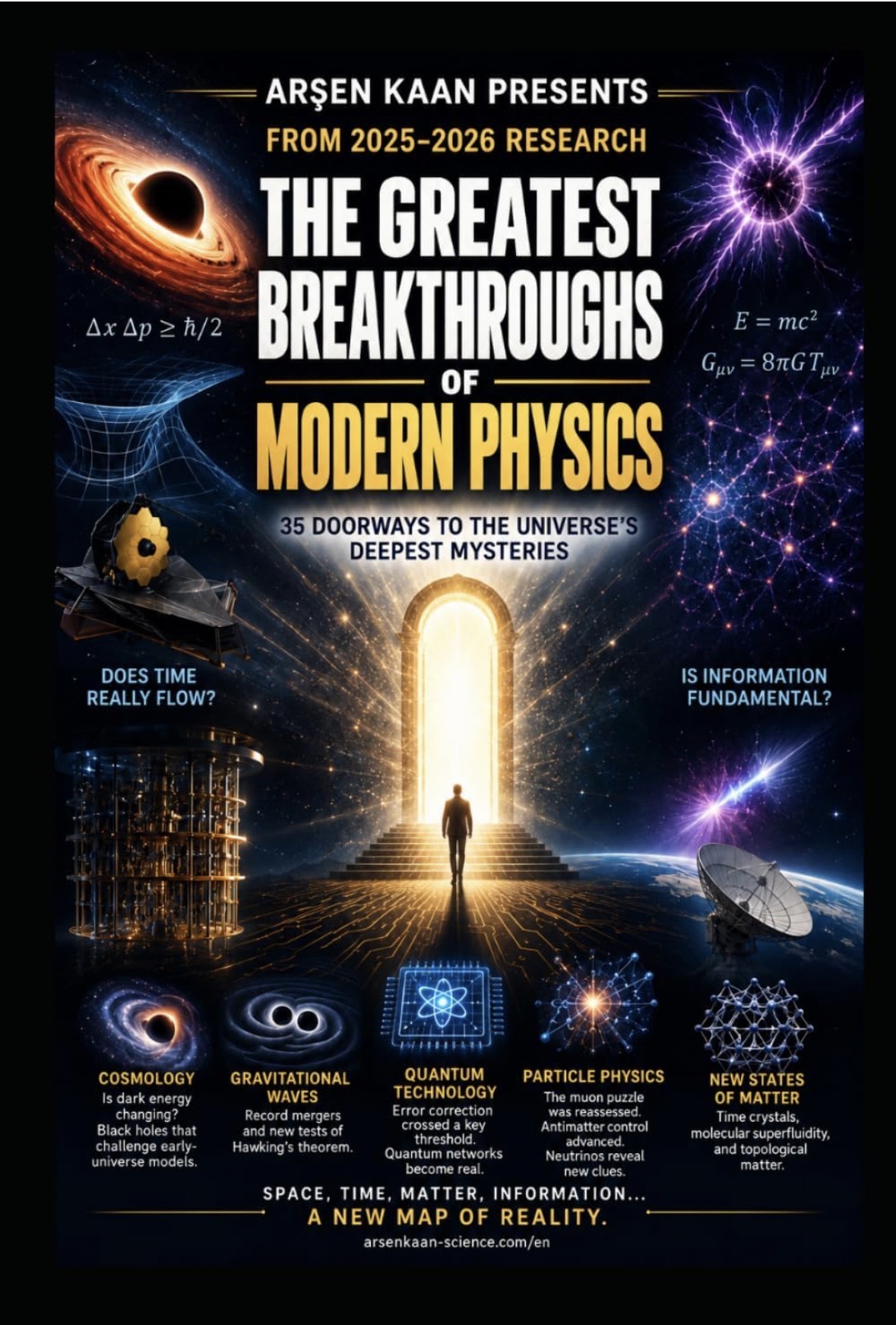
Breaking News: The Greatest Breakthroughs of Modern Physics Is Now Available in English

Today, Arşen Kaan expands his English-language catalogue with a new book examining 35 major developments from 2025–2026 research.

Read the full article

Modern physics is on the verge of a revolution.

What if some of the most fundamental assumptions of modern physics are about to be rewritten?

Today, Arşen Kaan’s English-language catalogue expands with The Greatest Breakthroughs of Modern Physics: The Most Important Developments from 2025–2026 Research.

A guide to a rapidly changing scientific landscape

Groundbreaking scientific studies published in 2025–2026 have revealed developments that could profoundly change the way we understand the universe.

New observations are challenging our current view of dark energy. The James Webb Space Telescope is discovering enormous black holes that appear to have formed far earlier than existing models would normally predict. Gravitational waves are opening an entirely new window onto the cosmos. Meanwhile, quantum computers are reaching milestones that seemed out of reach only a few years ago.

Thirty-five important developments

The book examines 35 of the most important scientific developments in modern physics from 2025–2026. It draws on current research while presenting complex ideas in clear, accessible language without compromising scientific accuracy.

Its themes span cosmology, gravitational waves, quantum technology, particle physics and new states of matter — a new map of reality shaped by current science.

Now available in English

The new English edition is available today. It is written for readers who want to understand not only what researchers have discovered, but why these results matter and which questions remain open.

Arşen Kaan Science Author
View the new English book on Amazon
A descent through matter toward the Planck scale and the limits of current physics

The Smallest Boundary in the Universe

At roughly 1.6 × 10⁻³⁵ metres, the Planck scale does not mark a proven smallest distance. It marks the regime where our current map of nature becomes incomplete.

Read the full article

Inside the universe, there may be a boundary so small that no microscope could ever see it directly.

Imagine starting from a human eye and diving into the pupil: tissue gives way to molecules, then to a single atom. But atoms are not the end.

From atoms to quarks

In school, electrons are often pictured orbiting an atomic nucleus like planets around the Sun. Quantum mechanics gives us a very different description: an electron is represented by a quantum state whose position is described probabilistically. Around the tiny, dense nucleus, it is better visualised as a diffuse probability cloud than as a miniature planet.

Inside the nucleus are protons and neutrons. Inside them are quarks, bound by the strong interaction and its gluon field. As far as present experiments can determine, quarks and electrons behave as elementary particles with no resolved internal structure.

High-energy collider experiments probe extraordinarily short distances, roughly down to the 10⁻¹⁹–10⁻¹⁸ metre range depending on the process and interpretation. Yet even that is still enormously larger than the Planck scale.

The logarithmic descent

10⁻¹⁵ m — proton scale

10⁻¹⁸ m — collider scale

10⁻²⁵ m

10⁻³⁰ m

10⁻³⁵ m

And there it is:

PLANCK LENGTH ≈ 1.6 × 10⁻³⁵ METRES

This does not prove that the Planck length is the smallest possible distance. It identifies a scale at which our present descriptions of nature are expected to become incomplete.

Where our current map stops working

On one side stands general relativity: curved spacetime, black holes, gravitational waves and Einstein’s field equations.

On the other stands quantum theory: quantum fields, probability amplitudes and the microscopic behaviour of matter.

Near the Planck regime, these frameworks cannot simply be combined using the methods that work at ordinary energies. Straightforward calculations can generate uncontrolled divergences, signalling that a deeper theory of quantum gravity is needed.

Physics itself does not collapse. Our map becomes incomplete.

What could lie underneath?

String theory proposes that point-like particles may be replaced by unimaginably small vibrating strings, with different vibrational states corresponding to different particles. This framework has not been experimentally confirmed.

Loop quantum gravity explores whether geometry itself has a discrete quantum structure described by spin networks. This should not be reduced to the simple claim that space is made of ordinary pixels.

Other research programmes include causal-set theory and asymptotic safety.

There are multiple serious approaches, but no final experimentally established answer.

The deepest remaining question

We descended from atoms to nuclei and from nuclei to quarks. Below the scales we can currently test, one question remains:

What is spacetime itself made of?

Vibrating strings? Quantum geometry? A causal structure? Or something humanity has not yet imagined?

The smallest scales may hide the universe’s greatest mystery.

THE PLANCK SCALE

WHERE OUR CURRENT THEORIES BECOME INCOMPLETE

Arşen Kaan arXiv Series

Sources: CERN Standard Model resources and research literature on quantum gravity, string theory, loop quantum gravity, causal sets and asymptotic safety.

CERN · The Standard Model
Conceptual illustration of a contracting universe reaching a cosmological bounce

What If the Big Bang Wasn’t the Beginning?

A new semiclassical preprint explores how a trace anomaly could replace a primordial singularity with a transition from contraction to expansion.

Read the full article

The standard cosmological picture successfully describes an expanding universe, but extrapolating classical general relativity far enough into the past leads to a singularity. Many physicists interpret that singularity not as a known physical object, but as a sign that the classical theory has reached its limit.

A recent preprint by Wagno Cesar e Silva, Nicolas R. Bertini and Ilya L. Shapiro studies a different possibility: the expanding universe may have been preceded by a contracting phase that avoided the singularity through a semiclassical cosmological bounce.

What is the trace anomaly?

Classically, the energy–momentum tensor of radiation has a vanishing trace. Quantum effects can change that result. After renormalisation, the expectation value of the trace need not vanish: ⟨Tᵘᵤ⟩ ≠ 0. This is known as a trace, or conformal, anomaly.

The anomaly is not a random “quantum glitch.” It is a calculable consequence of quantum field theory in curved spacetime. Its contribution depends on the field content and the associated beta functions.

How the bounce appears in this model

In the scenario examined by the authors, an initially contracting universe is not empty. As contraction raises the temperature and density, its matter content behaves increasingly like radiation. The anomaly-induced contribution then modifies the semiclassical gravitational equations.

For a positive overall beta function in the matter sector, the model can generate a nonsingular bounce: contraction slows, reaches a minimum scale and changes into expansion. In that limited, effective sense, the quantum correction opposes continued collapse.

This does not mean that gravity universally becomes repulsive whenever density is high. The result belongs to a specific semiclassical framework and depends on assumptions about quantum fields, the effective action and the cosmological background.

What is new in arXiv:2608.09720?

The paper develops a low-energy form of the nonlocal anomaly-induced effective action. The authors rewrite the action locally by introducing auxiliary scalar fields, avoiding higher derivatives in the resulting formulation. This is intended as groundwork for studying primordial cosmological perturbations in the bounce scenario.

What remains unproven

No observation has established that our universe passed through an earlier contracting phase. The preprint does not provide direct evidence for a pre–Big Bang universe, and it has not turned the bounce into a confirmed replacement for standard early-universe cosmology.

The scientifically careful conclusion is narrower but still important: within this semiclassical model, quantum trace-anomaly effects can produce a mathematically consistent nonsingular bounce under stated conditions. Whether that model describes our universe will depend on its perturbation predictions, theoretical consistency and future observational tests.

Arşen Kaan

e Silva, Bertini & Shapiro · arXiv:2608.09720
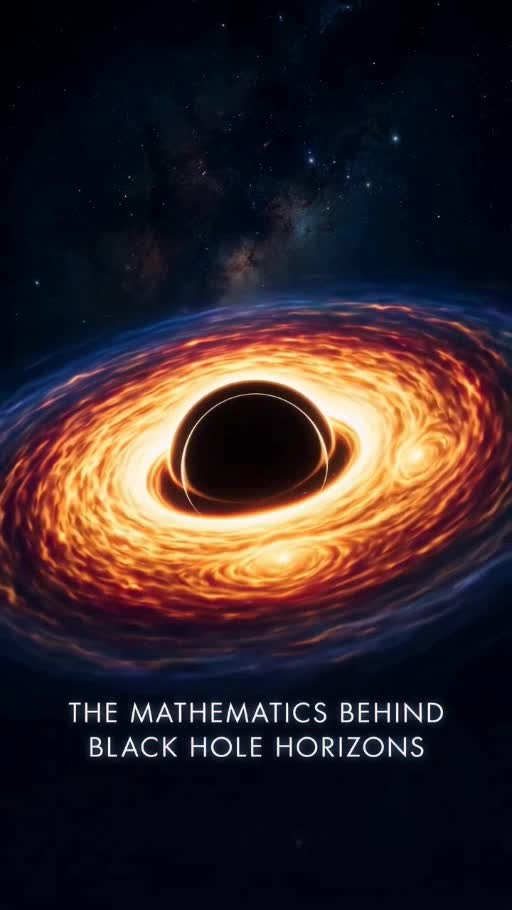
Illustration explaining modular theory and quantum fields near a black-hole horizon

Are We Getting Closer to Understanding Black Hole Horizons?

A new theoretical study connects modular flow, affine symmetries and the Unruh effect in an idealised Rindler-horizon model.

Read the full article

Black holes are among the most mysterious objects in the universe. Their defining feature is the event horizon — a boundary beyond which nothing, not even light, can escape.

But one of the deepest questions in modern theoretical physics is not simply what a black hole looks like. It is this: how do quantum fields behave near a horizon?

A recent theoretical study may offer a clearer mathematical way to think about that question.

A Rindler horizon as a theoretical laboratory

The researchers did not study an astrophysical black hole directly. Instead, they used a simplified but extremely important model known as a Rindler horizon.

A Rindler horizon appears when an observer undergoes constant acceleration in flat spacetime. Mathematically, it shares several local properties with a black-hole horizon, which makes it a powerful theoretical laboratory for studying quantum field theory near horizons.

The work focuses on the relationship between modular theory, affine symmetries, quantum algebras and the Unruh effect.

Why the vacuum can look thermal

The quantum vacuum is not as simple as it appears. For an inertial observer, empty space may look like vacuum. But for a uniformly accelerating observer, that same vacuum can appear thermal. This phenomenon is known as the Unruh effect.

The remarkable point is that this thermality is deeply connected to mathematical symmetries. This is where Tomita–Takesaki modular theory becomes important.

Instead of describing quantum physics only in terms of particles, modular theory studies the algebra of observables associated with a region of spacetime. In this framework, vacuum structure, quantum entanglement, thermal behaviour and spacetime symmetries can be connected within a single mathematical language.

Modular flow and affine symmetry

The study examines how modular flow on the Rindler horizon is related to dilations and affine transformations. In simple terms, the researchers show that the thermal behaviour seen by accelerated observers can be understood through a minimal symmetry structure acting on the horizon.

Another important ingredient is the Mellin transform. It provides a natural bridge between Minkowski modes and Rindler modes, helping reveal how different descriptions of the same quantum field are related. This gives a more unified group-theoretic picture of the Unruh effect.

What the result does — and does not — establish

The study does not solve the black-hole information paradox. It does not provide a complete theory of quantum gravity, and it does not describe realistic astrophysical black holes in full detail. The analysis is based on an idealised Rindler horizon and a simplified quantum-field model.

Its broader significance is nevertheless important. Modern approaches to black-hole thermodynamics, Hawking radiation, quantum gravity and holography increasingly rely on the algebraic structure of quantum field theory.

Modular theory may therefore become an increasingly important language for understanding how spacetime, thermality and quantum information are connected.

One profound possibility is that spacetime geometry itself may not be the most fundamental structure. Geometry could instead emerge from deeper relationships between quantum states, operator algebras and modular flow. That idea remains speculative, but it is an active direction in modern theoretical physics.

Perhaps the deepest secrets of black holes will not be revealed only by larger telescopes. Perhaps they will also be uncovered through the mathematics hidden inside quantum theory.

Arşen Kaan

Arzano & Palumbo · arXiv:2606.01071English book editionGerman book editionTurkish book edition
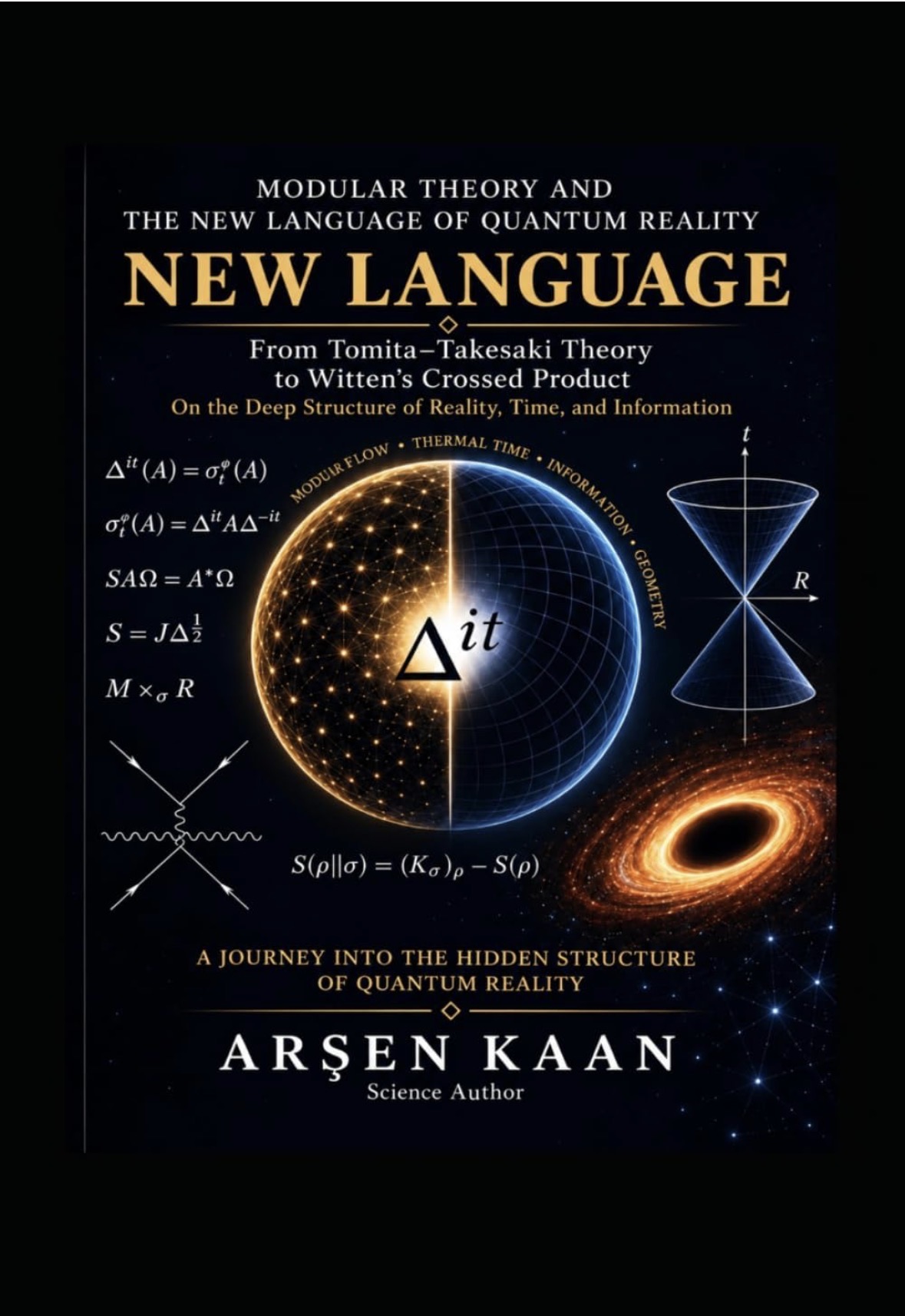
English cover of Modular Theory and the New Language of Quantum Reality by Arşen Kaan

Breaking News: Modular Theory and the New Language of Quantum Reality Is Now Available in English

Following the Turkish and German editions, Arşen Kaan’s book on modular theory, time, information and spacetime is now available in English.

Read the full article

One of modern theoretical physics’ deepest questions is deceptively simple: are space, time, matter and gravity fundamental, or could they emerge from a deeper quantum-informational structure?

Arşen Kaan’s Modular Theory and the New Language of Quantum Reality explores this question through Tomita–Takesaki modular theory, operator algebras, quantum field theory and recent discussions of quantum gravity.

What does “modular” mean?

At the algebraic level, quantum observables can be organised in von Neumann algebras. Given a suitable algebra and state, Tomita–Takesaki theory constructs a modular operator and a canonical flow: σₜ(A) = ΔⁱᵗAΔ⁻ⁱᵗ.

This mathematical flow is not automatically ordinary physical time. Yet in important settings it acquires a geometric meaning. The Bisognano–Wichmann theorem, for example, connects modular flow for a Rindler wedge with Lorentz boosts. Such results motivate the careful question of whether time and geometry may sometimes be recovered from deeper algebraic relations.

Why crossed products matter

Local algebras in relativistic quantum field theory are generally Type III and do not possess the ordinary finite trace familiar from elementary quantum mechanics. By enlarging an algebra to incorporate its modular flow, the crossed product M ⋊σ ℝ can provide a semifinite setting in which trace- and entropy-related questions become more manageable.

Recent work in gravitational physics, including discussions associated with Edward Witten, has brought this construction into renewed focus. The book follows the conceptual route from Tomita–Takesaki theory to these crossed-product methods.

Information, geometry and black holes

Black-hole thermodynamics, holography, entanglement and relative entropy suggest that matter, information and geometry may not be independent layers of reality. Modular theory supplies a precise mathematical vocabulary with which some of these connections can be investigated.

The book does not claim that emergent time or emergent spacetime has been experimentally established. It presents a research frontier: a shared framework in which modular flow, KMS states, Type III factors, relative entropy, holography and quantum gravity can be examined together.

A new international edition

Following the Turkish and German editions, the English edition opens this discussion to a wider readership interested in mathematical physics, quantum foundations, spacetime emergence and quantum information.

The central question is no longer only: how does the quantum world work? A deeper question may be: from what underlying structure do time, geometry, information and physical reality itself emerge?

View the English edition on Amazon
Operator algebras, modular flow, geometry and matter arranged around a black-hole illustration

Is Spacetime Written in Algebra?

A growing research programme asks whether spacetime geometry — and perhaps matter sectors — can emerge from operator algebras, quantum states and their modular structure.

Read the full article

For more than a century, fundamental physics has repeatedly demoted structures once considered elementary. Quantum field theory treats particles as excitations of fields; general relativity makes spacetime geometry dynamical. Quantum gravity now raises a deeper question: could spacetime itself be emergent?

From objects to relations

Algebraic quantum field theory assigns an algebra of observables 𝒜(O) to a spacetime region O. The algebra specifies which measurements are possible and how they relate. This replaces a picture built only from objects with one in which relations between observables carry primary information.

The Tomita–Takesaki mechanism

For a von Neumann algebra M and a suitable cyclic and separating state Ω, the Tomita operator has the polar decomposition S = JΔ¹ᐟ². The modular operator Δ generates a one-parameter automorphism group, σₜ(A) = ΔⁱᵗAΔ⁻ⁱᵗ.

The parameter is modular time, not automatically ordinary clock time. Yet in special settings the flow becomes geometric. For the vacuum restricted to a Rindler wedge, modular flow is associated with Lorentz boosts and KMS thermality.

Reconstructing geometry

Recent operator-algebraic work studies conditions under which causal, metric and curvature information may be recovered from algebras of quantum matter in semiclassical regimes. This does not prove that the universe is literally “made of algebra.” It changes the reconstruction problem: how much of spacetime can be derived from quantum observables rather than assumed in advance?

Modular geometry and holography

Modular Berry transport, entanglement-wedge reconstruction and quantum error correction provide related clues. In holographic models, the algebra of observables reconstructible from boundary data can correspond to a bulk region. Geometry and information accessibility begin to look like two descriptions of the same organisation.

Black holes as laboratories

Black holes combine quantum theory, gravity, thermodynamics and information. Their local quantum fields naturally involve Type III algebras, while gravitational extensions and crossed products can lead to Type II structures with a semifinite trace. This gives a controlled language for entropy and horizon observables without claiming that one construction has already completed quantum gravity.

What about matter?

Particles are already representation-dependent excitations in quantum field theory. Superselection theory shows how charge sectors can be encoded in representations of observable algebras. That motivates — but does not yet establish — a possible hierarchy: algebra → state → modular dynamics → geometry → fields → matter.

What remains open

A fundamental theory would still need to explain why the low-energy world is 3+1-dimensional, why the Standard Model has its observed gauge group and particle content, and what falsifiable predictions distinguish the framework from existing physics.

The scientifically careful conclusion is therefore neither “matter is an illusion” nor “the universe is software.” The stronger, defensible claim is that operator algebras and quantum states may contain far more geometric and dynamical information than traditional formulations make explicit. Perhaps matter and spacetime are not the beginning of the story, but macroscopic expressions of a deeper relational structure.

Mohan & Thorlacius · Spacetime from Operator AlgebrasWitten · Gravity and the Crossed ProductConnes & Rovelli · Thermal Time Hypothesis
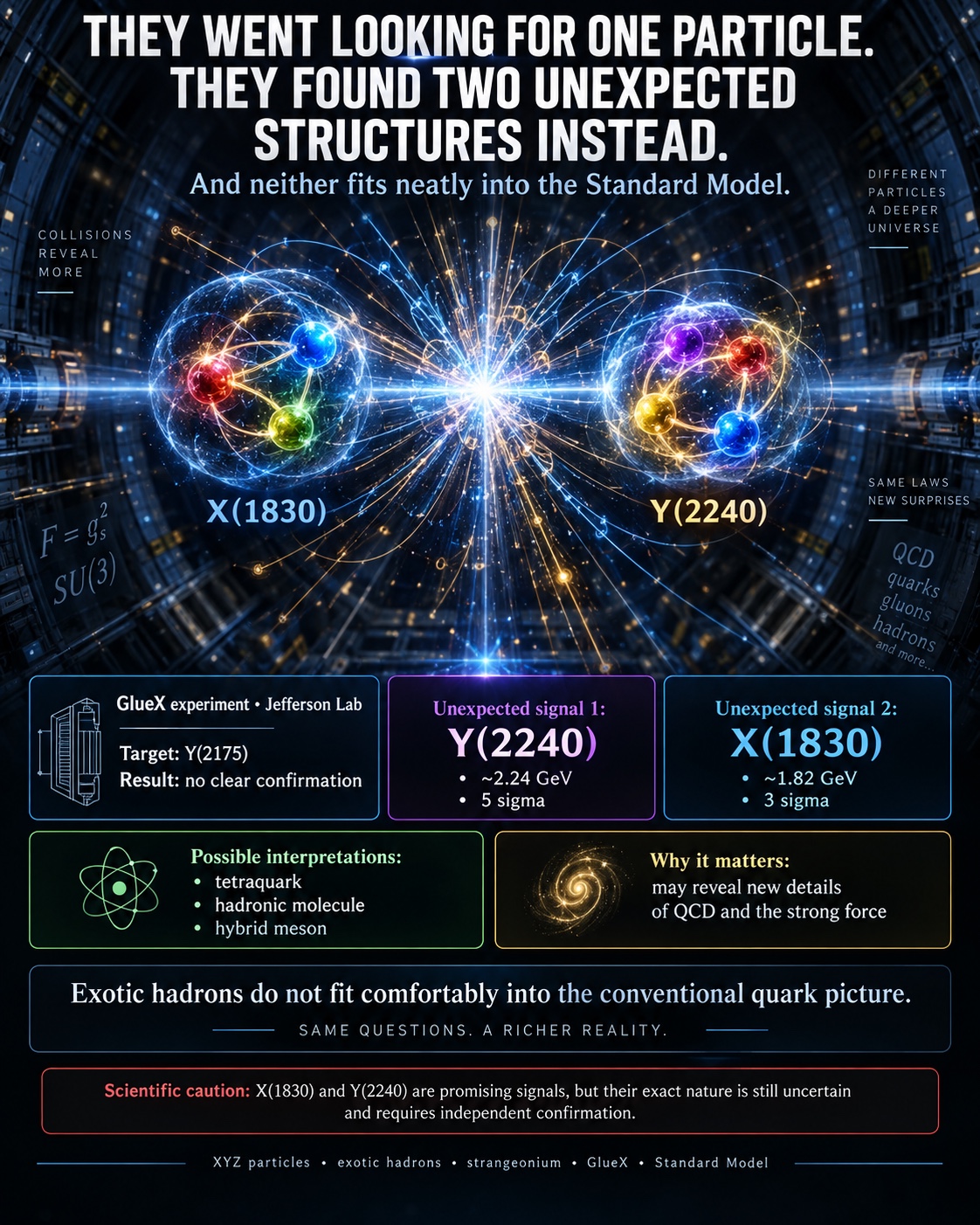
Illustration of the X(1830) and Y(2240) structures reported by the GlueX experiment

They Looked for One Particle — and Found Two Unexpected Structures

GlueX searched the strangeonium region for the reported Y(2175), but its data instead revealed evidence for structures near 1.82 and 2.24 GeV.

Read the full article

Particle physics once faced a “hadron zoo”: a growing catalogue of particles that only became intelligible after the quark model revealed a deeper organising principle. Today, the many short-lived X, Y and Z states are creating a new classification problem.

Using a high-energy photon beam on a liquid-hydrogen target, the GlueX experiment at Jefferson Lab studied the strangeonium region. The team was looking for the previously reported Y(2175), but did not see a clear confirmation of that state in the analysed channel.

Instead, the researchers reported two structures. One, labelled Y(2240), appears near 2.24 GeV with a local statistical significance of about five sigma. A second, X(1830), appears near 1.82 GeV with evidence at roughly three sigma.

Those signals do not yet tell physicists what the structures are. Possible explanations include conventional resonances, multiquark configurations, hadronic molecules, gluonic hybrid states or effects produced by interfering amplitudes. Determining the correct interpretation requires additional channels, detailed amplitude analyses and independent confirmation.

The result matters because quantum chromodynamics explains the strong interaction but remains difficult to solve in the energy regime where quarks and gluons bind into hadrons. New spectroscopy data can expose how that binding works.

The scientifically careful conclusion is therefore not that two exotic particles have been definitively discovered. GlueX has reported two significant structures whose precise nature remains open.

Jefferson Lab · Search in Strange Quark SectorPhysical Review Letters
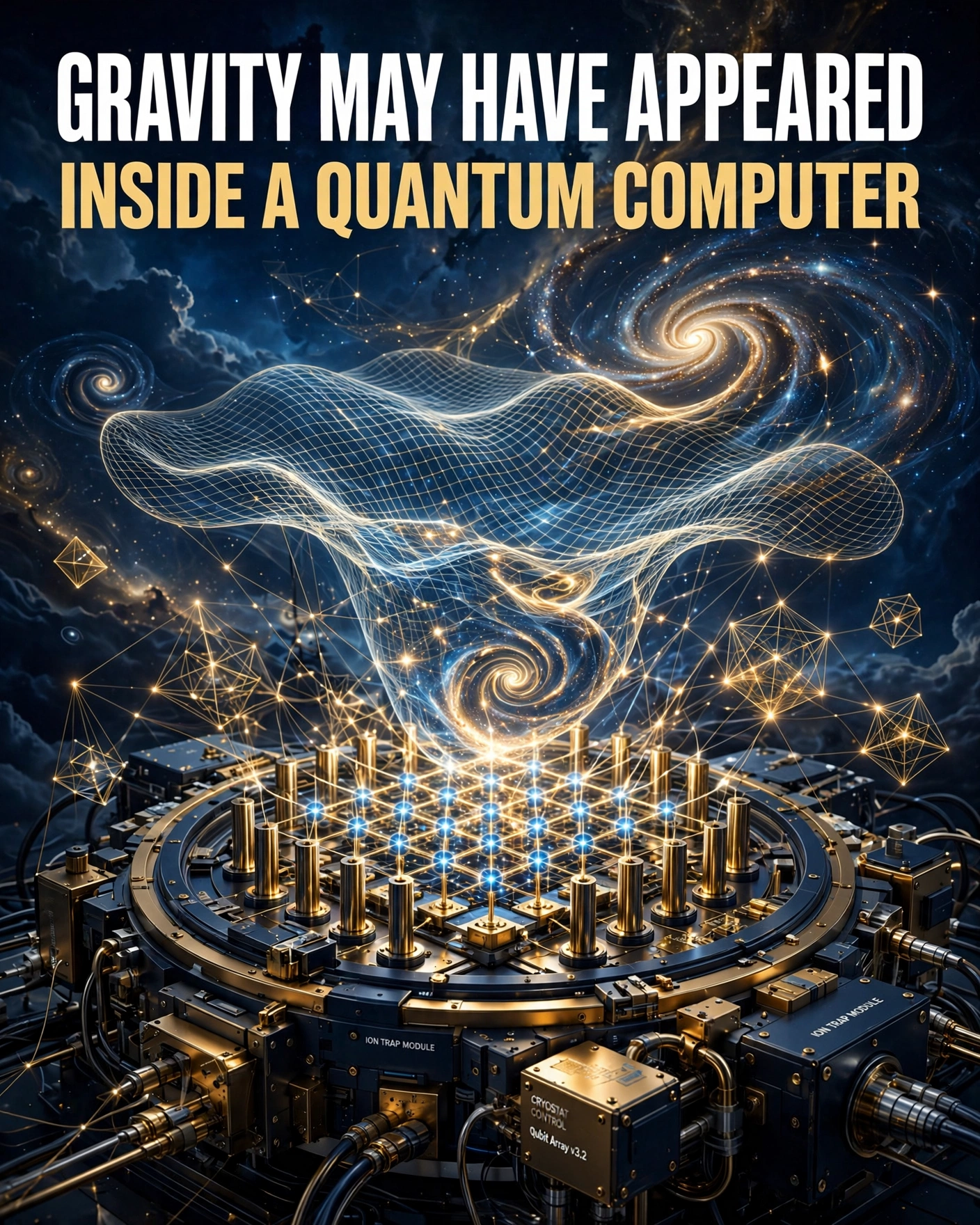
Conceptual image of a holographic quantum code and emergent geometry

Gravity-Like Signatures on a Quantum Computer

A trapped-ion implementation of the HaPPY code reproduced selected entropic relations associated with toy models of holographic gravity.

Read the full article

The experiment did not create real gravity, spacetime or a traversable wormhole. Researchers implemented the HaPPY code—a simplified holographic quantum error-correcting model—on a trapped-ion quantum computer.

In their 2026 preprint, the team reported an experimental test of the Faulkner–Lewkowycz–Maldacena relation inside this model. They then introduced non-stabilizer resources, often called magic, and measured entropic precursors expected in models of emergent gravity.

The researchers also built a code construction whose entropic behavior resembles that of a highly quantum wormhole. “Resembles” is essential: no tunnel through physical spacetime was opened and no object was transported. This was an analogue simulation of mathematical relationships in a controlled quantum system.

The result matters because parts of the quantum-information language used in holographic gravity can now be examined experimentally rather than only through equations. Quantum processors may therefore become useful testbeds for simplified models of emergent geometry.

But the HaPPY code is not a complete model of our universe, and the experiment does not prove that spacetime is made of quantum information. The careful conclusion is that a quantum computer reproduced selected gravity-like signatures predicted within a particular holographic toy model.

Biswas et al. · arXiv:2607.12047
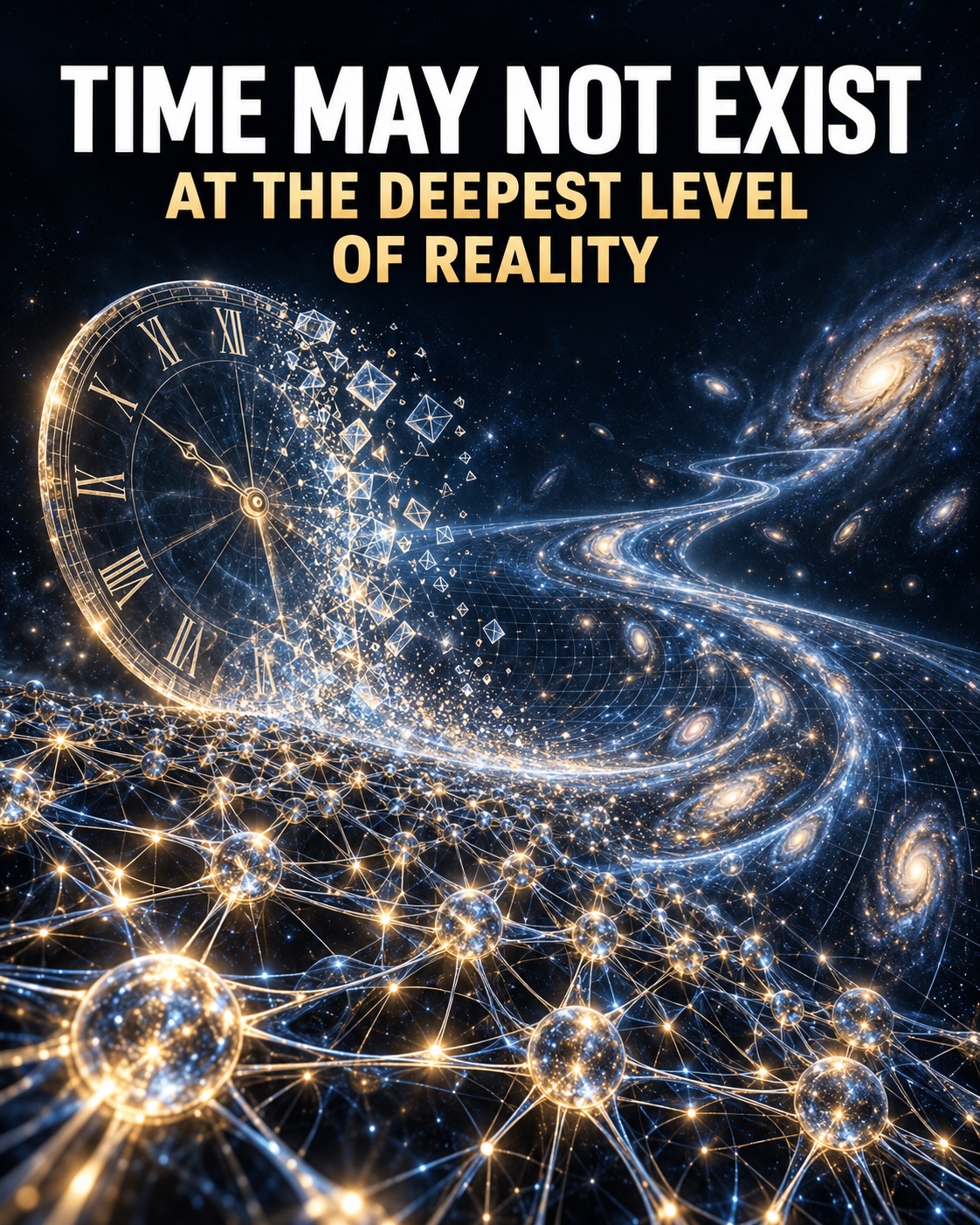
Could Time Emerge from Something Deeper? — illustrative artwork

Could Time Emerge from Something Deeper?

Some approaches explore emergent time. They do not establish that clocks, change or time itself are unreal.

Read the full article

Clocks measure durations, and relativity explains why different paths through spacetime can accumulate different amounts of proper time. Physics does not require one universal clock shared by every observer.

The question of whether time is fundamental arises in quantum gravity. Certain formulations describe a global state without an external time parameter, while changes can be described through correlations between subsystems. Turning that idea into a complete account of physical clocks remains a substantial problem.

The thermal time hypothesis offers another perspective. Given an appropriate algebra of observables and a state, modular theory supplies a mathematical flow. Identifying that flow with physical time is an additional proposal, not a consequence that applies automatically to every system.

Likewise, results relating spatial geometry to quantum entanglement do not by themselves explain the emergence of time or our experience of its passage. Temperature can offer an analogy for emergence, but an analogy is not a derivation.

These ideas are active theoretical explorations. They do not show that time is fake, nor that a specific model of emergent time has been experimentally established. The productive question is how known clock behaviour and relativistic dynamics might arise within a deeper description.

Connes and Rovelli · Thermal time hypothesis
Could Quantum Information Help Explain Spacetime? — illustrative artwork

Could Quantum Information Help Explain Spacetime?

Entanglement provides important clues in holographic models, but it has not replaced matter with information as an experimentally established foundation.

Read the full article

Atoms, particles and quantum fields are successful parts of our physical description. Asking whether a deeper description exists does not make their observed behaviour disappear.

In holographic approaches to quantum gravity, a gravitational spacetime can be related to a quantum theory with a different description of its degrees of freedom. The pattern of entanglement can be closely related to geometric connections in that spacetime.

Mark Van Raamsdonk explored how reducing entanglement between parts of a holographic quantum system can correspond to separating regions of the associated geometry. This is a concrete theoretical setting in which relationships between degrees of freedom help describe space.

It does not prove that our universe is a computer simulation. Nor does it demonstrate that matter, a brain or a memory consists of an independent substance called information. Information is defined through physical states, observables and their correlations; its interpretation must be specified.

The broader possibility that familiar spacetime emerges from a deeper quantum structure remains important. Yet a result in a particular holographic model is not a completed description of our cosmological universe.

The strongest conclusion is also the most interesting: quantum information gives physicists new tools for investigating geometry and gravity. Whether it ultimately supplies a fundamental account of all reality is still open.

Van Raamsdonk · Building up spacetime with quantum entanglement
Artist’s impression of the Chicxulub asteroid approaching Earth as dinosaurs flee

A Tiny Asteroid May Have Changed the Course of Humanity

The Chicxulub impact helped end the age of non-avian dinosaurs and opened ecological opportunities for mammals — but human evolution was never inevitable.

Read the full article

Sixty-six million years ago, a roughly 10-kilometre-wide asteroid struck near today’s Yucatán Peninsula. The impact formed the Chicxulub crater and released enough energy to transform conditions across the planet.

Rock, dust, soot and sulfur-rich aerosols were driven into the atmosphere. Sunlight diminished, temperatures fell and photosynthesis was disrupted. The resulting collapse of food webs contributed to the end-Cretaceous mass extinction, in which about three-quarters of species disappeared.

The impact is strongly supported as the principal trigger of that extinction, although the environmental crisis unfolded through several interacting processes. Non-avian dinosaurs were among its most famous victims, while birds, mammals and many other groups survived in reduced and unevenly distributed populations.

The disappearance of dominant dinosaur lineages created ecological opportunities that surviving mammals later exploited. Mammals diversified dramatically during the Cenozoic, and one much later branch eventually produced primates, hominins and Homo sapiens.

It is therefore reasonable to say that the impact changed the evolutionary conditions from which humans eventually emerged. But the counterfactual remains uncertain: science cannot prove exactly what would have evolved had the asteroid missed Earth, and human evolution was not a predetermined outcome.

The event is a powerful reminder that biological history can turn on planetary-scale accidents. For one set of organisms, Chicxulub marked catastrophe. For others, it opened a world of new possibilities.

Chicxulub impact review · ScienceSmithsonian · Dinosaur extinction
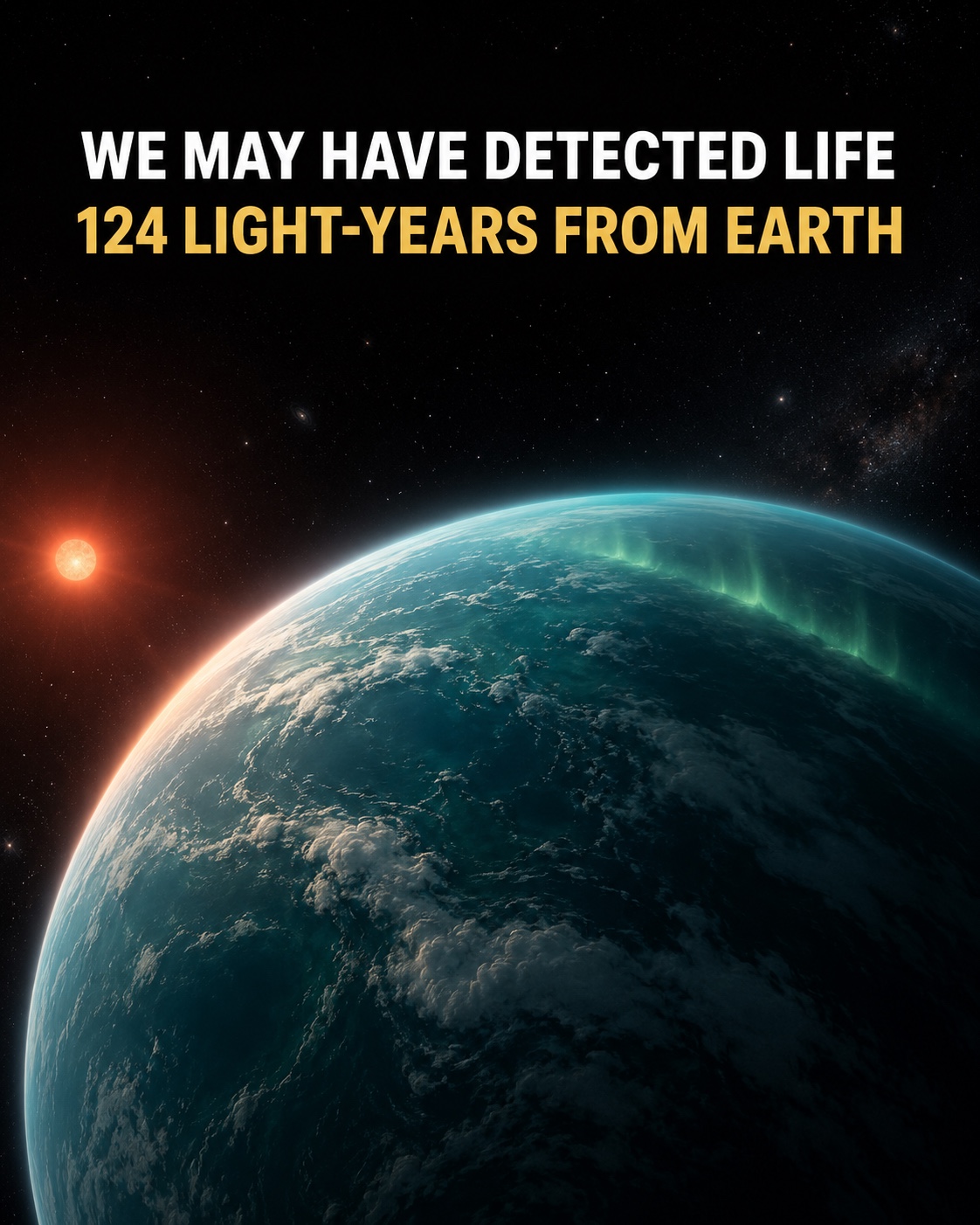
Artist’s impression of the exoplanet K2-18b orbiting a red dwarf star

Did JWST Detect a Possible Biosignature 124 Light-Years Away?

One team reported tentative evidence for DMS and/or DMDS on K2-18b, but independent analyses do not find a robust detection. No life has been detected.

Read the full article

For decades, humanity has asked whether we are alone. The exoplanet K2-18b, about 124 light-years away, has become one of the most closely watched places in that search.

K2-18b orbits within its star’s habitable zone, but that does not automatically make it habitable. It is a sub-Neptune more than twice Earth’s radius, and scientists still debate whether it has an ocean beneath a hydrogen-rich atmosphere or a much deeper gaseous envelope.

In 2025, a team led by Nikku Madhusudhan analysed a JWST MIRI transmission spectrum and reported tentative, roughly three-sigma evidence consistent with dimethyl sulfide (DMS) and/or dimethyl disulfide (DMDS).

On Earth, DMS is produced mainly by biological activity, especially marine microorganisms. That makes it interesting as a possible biosignature — but not a unique or automatic sign of life. Abiotic sources, incomplete molecular data and model choices must also be considered.

The result remains controversial. Independent teams analysing JWST data have found that the MIRI spectrum can be fitted without a robust DMS or DMDS detection. A comprehensive reanalysis of the near-infrared observations confirmed methane but found no reliable evidence for DMS or carbon dioxide, and showed that an oxygen-poor mini-Neptune remains a viable interpretation.

This is how frontier science works: one analysis identifies a possible signal, other teams test whether it survives different reductions, molecular lists and atmospheric models, and new observations decide between them.

The accurate conclusion is therefore cautious. JWST has not detected life on K2-18b. It has produced atmospheric spectra that prompted a serious but unresolved biosignature debate. More precise observations and independent confirmation are required before any biological interpretation can be supported.

Even without a confirmed biosignature, the achievement is remarkable: astronomers can now probe the chemistry of a distant planet’s atmosphere and test the possibility of life with real data rather than speculation alone.

Madhusudhan et al. · ApJ Letters / arXivComprehensive reanalysis · The Astronomical JournalJoint JWST reanalysis · Astronomy & Astrophysics
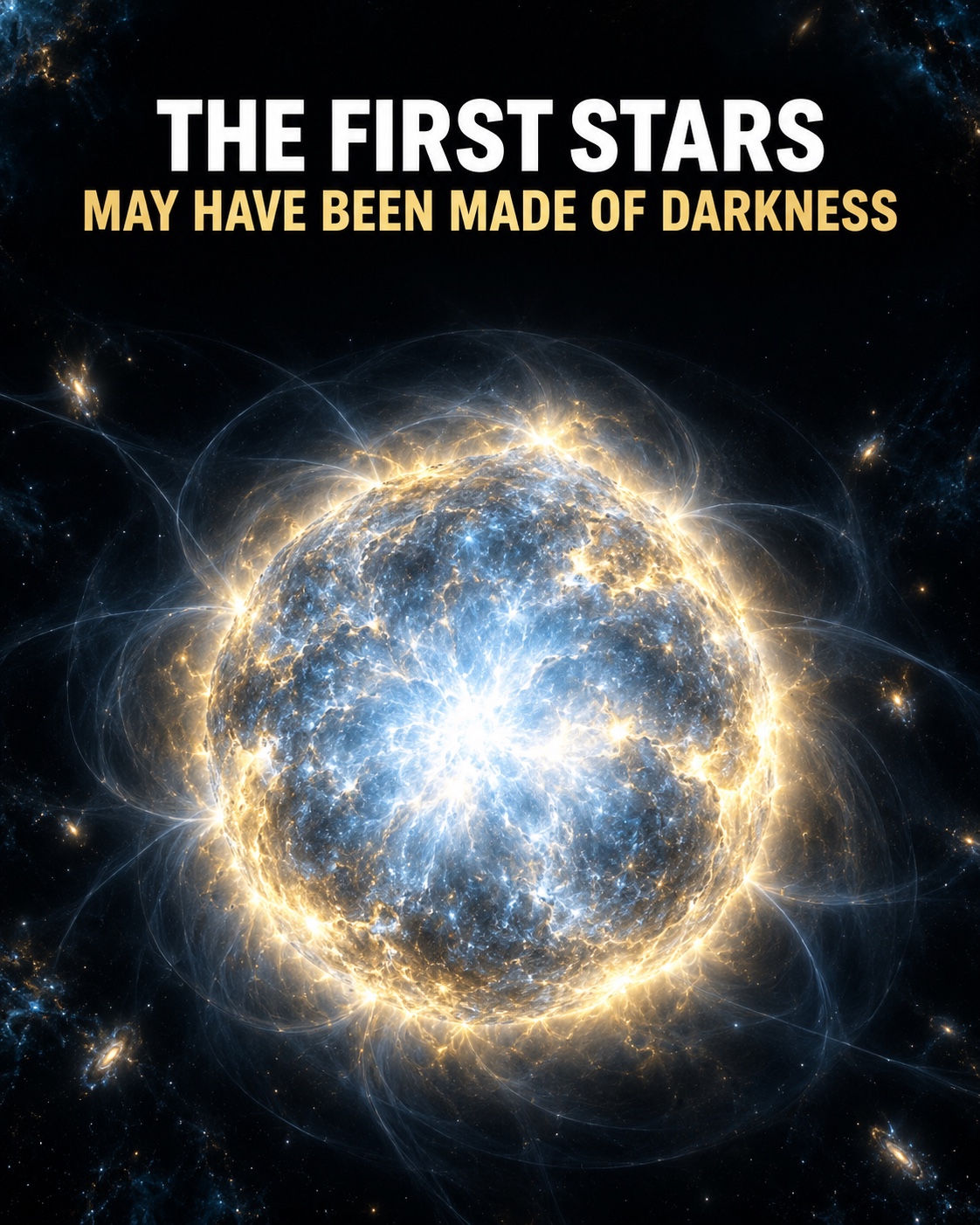
Artist’s impression of a luminous supermassive dark-star candidate in the early universe

The First Giant Stars May Have Been Powered by Dark Matter

Four distant JWST objects are spectroscopically consistent with supermassive dark-star models, but none has been confirmed as a dark star.

Read the full article

Stars forged much of the carbon, oxygen and other heavy elements that later became planets and living organisms. But some of the earliest luminous objects may have been powered by a radically different mechanism.

Dark-star theory proposes that primordial objects made mostly of hydrogen and helium could have been heated by the annihilation of dark-matter particles rather than initially relying on ordinary nuclear fusion. The released energy could delay collapse and allow the objects to grow to enormous masses.

Some models predict supermassive dark stars reaching hundreds of thousands or even millions of solar masses. Their eventual collapse could provide heavy seeds for the supermassive black holes that astronomers observe surprisingly early in cosmic history.

JWST has now supplied spectra for extremely distant JADES objects. In a 2025 PNAS study, researchers found that two previously proposed candidates, JADES-GS-z11-0 and JADES-GS-z13-0, remained consistent with dark-star models. They also identified JADES-GS-z14-0 and JADES-GS-z14-1 as additional spectroscopic candidates.

One object, JADES-GS-z14-0, showed a tentative absorption feature that could match a predicted helium signature. However, ALMA also detected likely oxygen emission associated with the source, making the simple picture of an isolated dark star less plausible.

These objects are therefore candidates, not discoveries of dark stars. Young galaxies, supermassive primordial stars and other astrophysical systems can produce overlapping observational signatures. Better spectra and diagnostic features are needed to distinguish among them.

If even one candidate were confirmed, the consequences would be profound. It would reveal a new phase of stellar evolution, provide information about dark matter and offer a possible route to the rapid appearance of massive black holes.

For now, the most accurate statement is also the most exciting: JWST has found distant objects compatible with a remarkable hypothesis, and astronomy finally has observations capable of testing it.

Spectroscopic dark-star candidates · PNASEarlier JWST candidates · PNASOriginal dark-star framework · Physical Review Letters
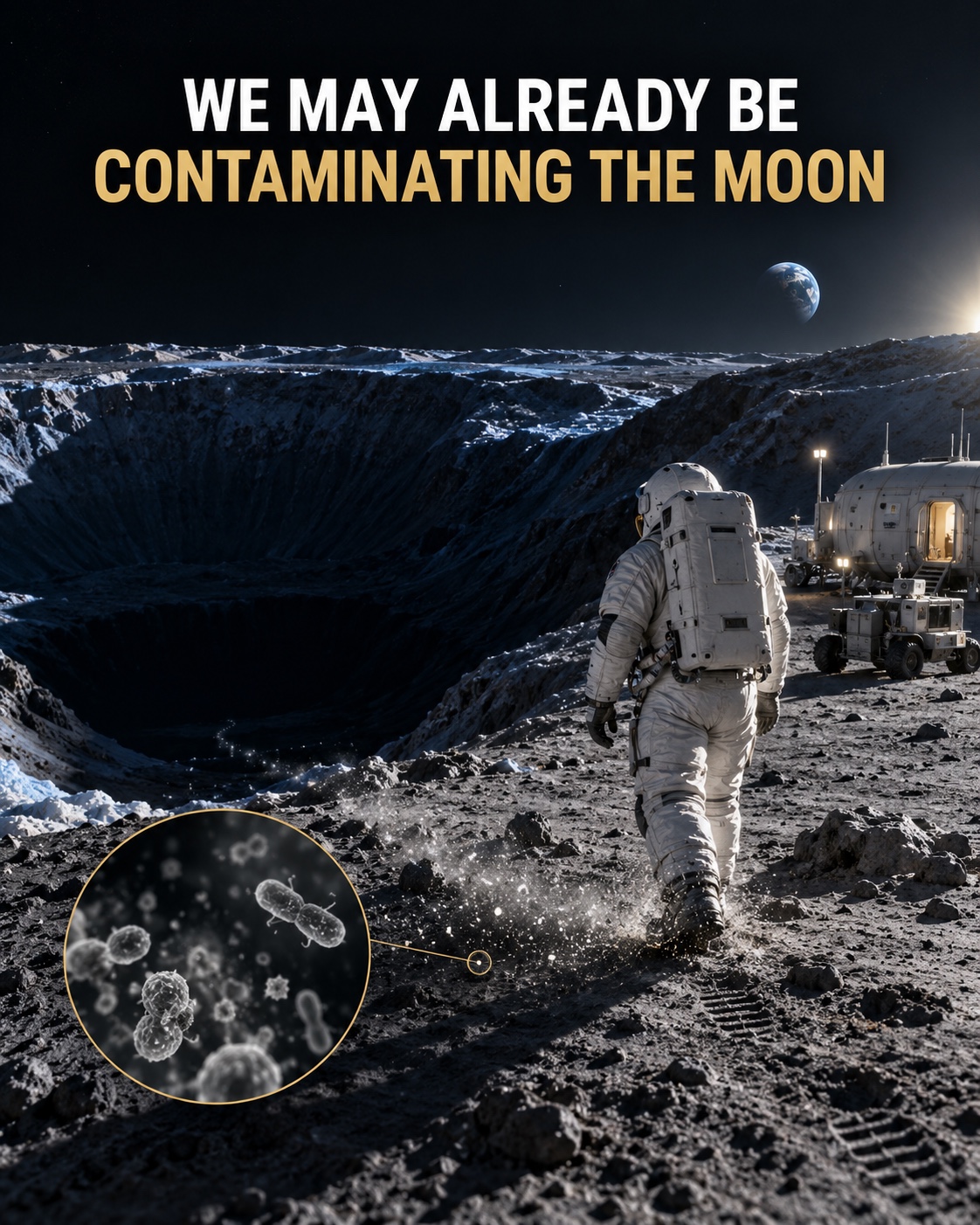
Astronaut near a shadowed lunar crater with an inset showing microorganisms

We May Already Be Contaminating the Moon

A NASA-led study suggests that some microbes carried by humans could persist in sheltered niches near the Moon’s south pole, complicating future science.

Read the full article

When humans return to the Moon, we will not go alone. Spacecraft, tools, habitats and spacesuits will inevitably carry microorganisms associated with Earth and the human body.

For a long time, the lunar surface seemed like a natural steriliser: it has no substantial atmosphere, experiences extreme temperatures and is exposed to intense ultraviolet and cosmic radiation. A NASA-led study published in 2026, however, suggests that conditions near the lunar south pole may be more complicated.

Using lunar temperature and radiation data together with laboratory knowledge of five bacteria and fungi, researchers mapped small sheltered niches where some organisms might remain viable. Permanently shadowed terrain, cold seasons and even very small patches of shade may protect dormant microbes from the harshest exposure.

The study concerns survival, not active growth or a self-sustaining lunar ecosystem. Some tested microorganisms may persist for at least a lunar day in favourable niches, while the hardy fungus Aspergillus niger could potentially survive longer under limited exposure.

This matters because the Moon’s south polar region is a major destination for future missions. Permanently shadowed craters may contain ancient water ice and preserve chemical records of the Moon’s history. Earth organisms deposited by astronauts or equipment could alter samples or make later measurements harder to interpret.

The same planetary-protection problem extends beyond the Moon. Future missions searching for signs of life on Mars must be able to distinguish an indigenous biological signal from contamination transported from Earth.

Contamination cannot be reduced to zero. Human skin, equipment and habitats continuously shed biological material. The practical goal is therefore to document, minimise and monitor what we bring.

There is also a scientific opportunity: carefully controlled experiments on the Moon could reveal how long terrestrial microbes remain viable in extraterrestrial environments that are difficult to reproduce perfectly on Earth.

The question is no longer only whether life exists beyond Earth. It is also whether we can explore another world without confusing its history with traces of our own.

Scientific note: The study identifies potential survival niches based on modelling and experimental tolerance data. It does not show that introduced microbes are currently growing on the Moon.

NASA ScienceScience Advances study
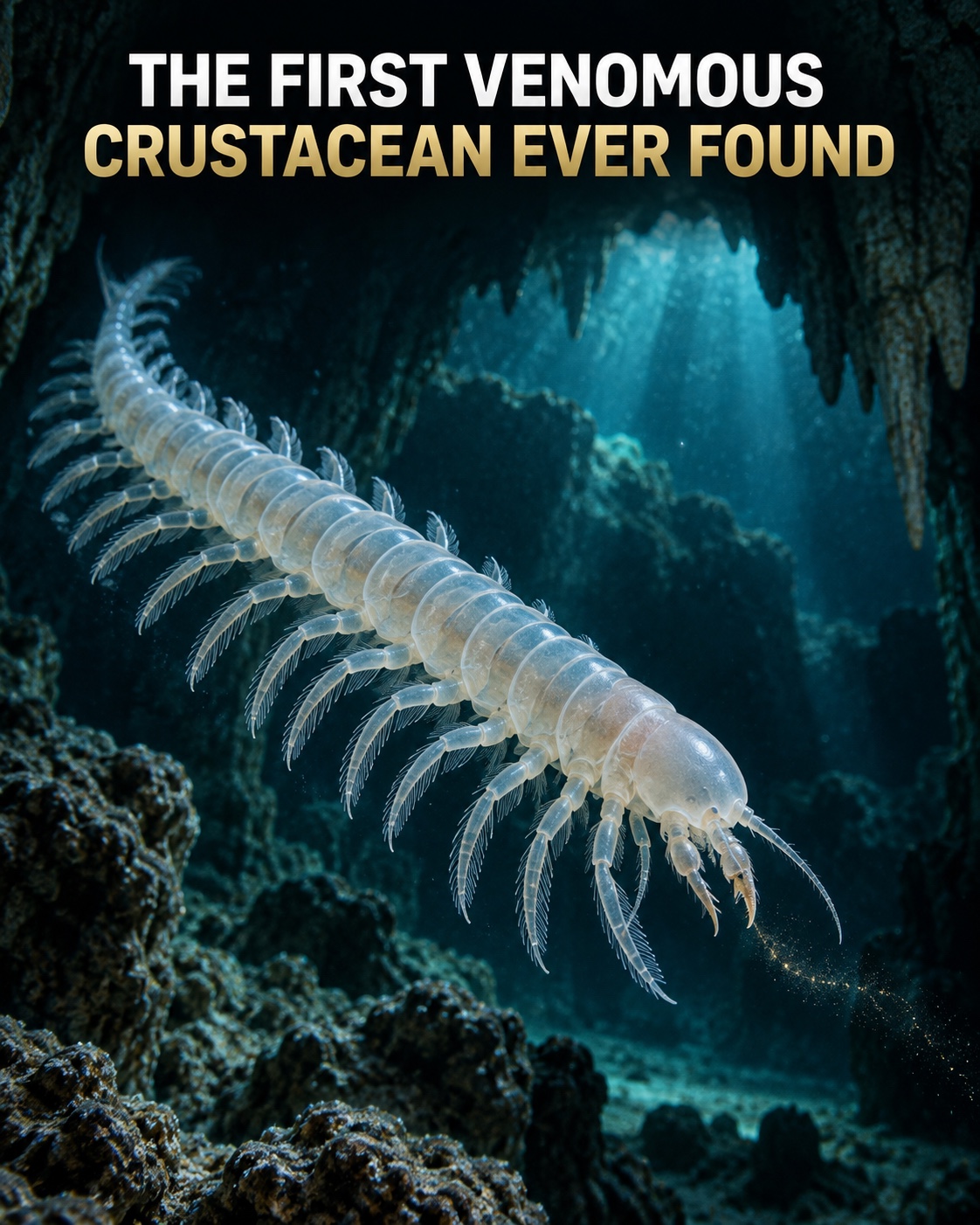
Blind remipede crustacean swimming in a submerged cave

Scientists Found the First Known Venomous Crustacean

The cave-dwelling remipede Xibalbanus tulumensis is the only crustacean with a described venom system, and its xibalbin peptides may inform future pharmacology.

Read the full article

Spiders, scorpions and many snakes use venom, but crustaceans were long thought to be an exception. That assumption changed with the study of a blind, cave-dwelling remipede from the Yucatán Peninsula: Xibalbanus tulumensis.

This unusual animal lives in anchialine cave systems — flooded underground environments where fresh and marine waters meet. It has no functional eyes and hunts other small crustaceans in darkness.

Researchers showed that Xibalbanus possesses a specialised venom-delivery system connected to its front limbs. The secretion contains enzymes and peptide toxins that can help immobilise prey and begin breaking down tissues before feeding.

The finding made remipedes the first, and so far only, crustaceans with a formally described venom system. It overturned the older idea that venom was absent from a group containing tens of thousands of known species.

Scientists later characterised a family of peptides called xibalbins. Several have an inhibitor cystine-knot structure, a compact molecular arrangement known for resisting heat, enzymes and harsh chemical conditions.

Tests showed that all examined xibalbin variants inhibited potassium channels in mammalian systems. Xib1 and Xib13 also affected voltage-gated sodium channels and signalling in sensory neurons.

Ion channels control electrical activity in nerves, muscles and other cells, so highly selective molecules that modify them can become useful research tools or starting points for drug development. This does not mean that xibalbins are already treatments; their selectivity, safety, dosage and effects in living organisms require much more study.

A predator hidden in underwater caves has therefore revealed both an unexpected chapter in venom evolution and a collection of molecules with potential pharmacological value.

Scientific note: Xibalbanus tulumensis was described decades ago, and its venom system was reported before the recent xibalbin work. The newer research concerns the detailed molecular and pharmacological properties of its toxins, not the first discovery of the animal itself.

Goethe University FrankfurtXibalbin study · PubMed
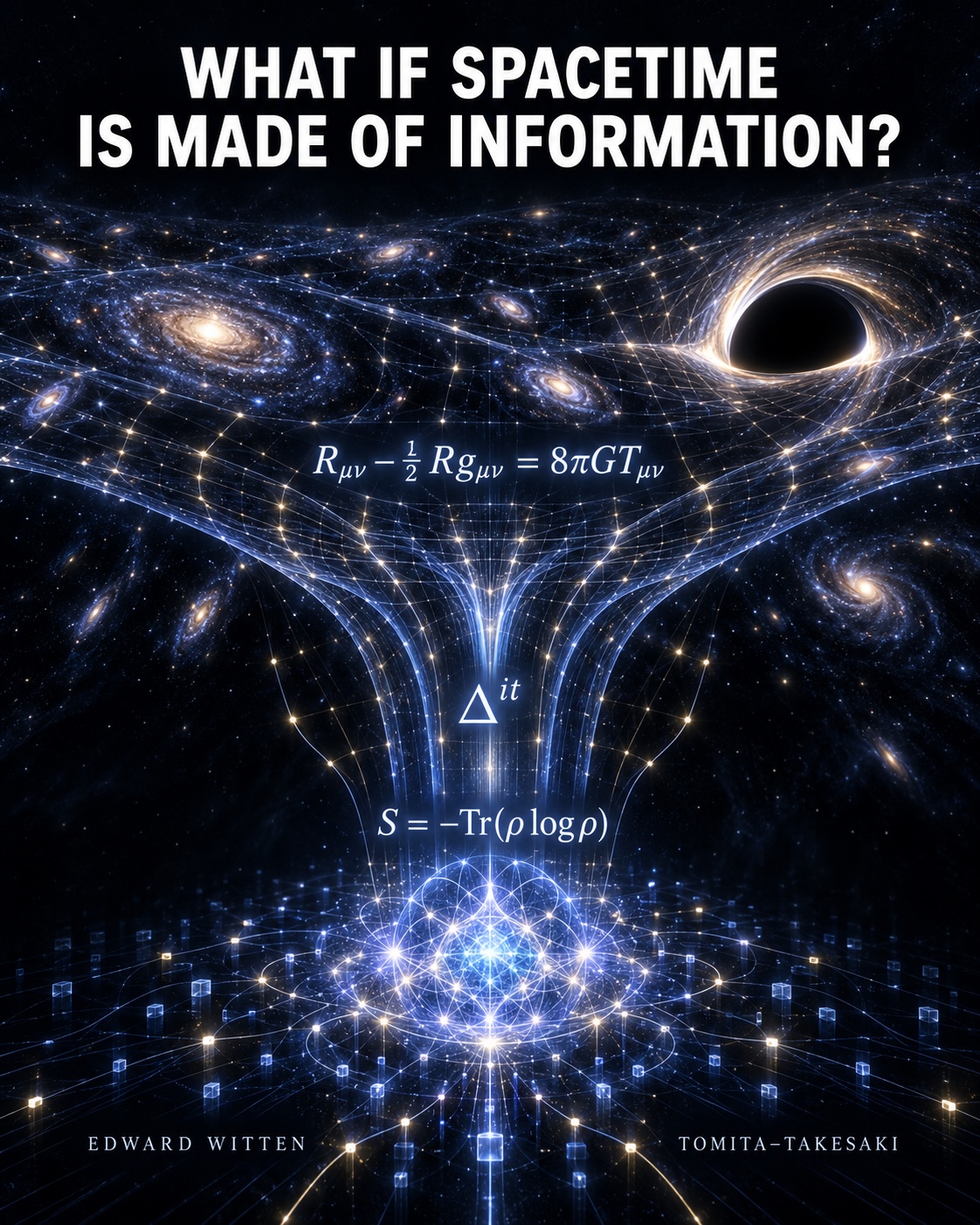
Cosmic spacetime emerging from quantum information with mathematical structures

Has Edward Witten Already Shown Us the Future of the Cosmos?

Some of the deepest ideas in modern theoretical physics suggest that spacetime may emerge from quantum information, entanglement and algebraic structure.

Read the full article

For decades, physicists have treated space and time as the fundamental stage on which reality unfolds. But what if spacetime itself is not fundamental? What if the universe emerges from something deeper?

This possibility lies at the heart of several influential research programmes in modern theoretical physics, many connected to the work of Edward Witten, one of the most influential mathematical physicists of our time.

Beyond Space and Time

Traditional physics treats spacetime as the background structure of reality. Work in string theory, quantum gravity and holography suggests a different picture. In several modern frameworks, geometry may emerge from quantum information, entanglement and deeper algebraic structures.

The universe may not ultimately be built from particles moving through a pre-existing space. Instead, space itself may arise from relationships between quantum systems.

The Holographic Revolution

One of the most remarkable developments in theoretical physics is the holographic principle. According to this idea, the physics inside a volume of space may be encoded by a theory defined on a lower-dimensional boundary.

In simple terms, a higher-dimensional gravitational world can, in certain theoretical settings, have an equivalent lower-dimensional description. This does not establish that our everyday three-dimensional cosmos is literally a projection on a physical outer wall. It is a mathematically precise duality in specific models and an important clue about quantum gravity.

Witten’s Lasting Influence

Edward Witten did not merely contribute to string theory. His work connected geometry, topology, quantum field theory and gravity in ways that continue to shape modern research.

Researchers now ask whether spacetime emerges from quantum entanglement, whether gravity can be understood through information, and whether parts of the universe can be reconstructed from algebraic relations rather than fundamental geometric objects.

A New Picture of the Universe

The next revolution in fundamental physics may reveal that spacetime is not the foundation of reality but a consequence of something deeper. If that happens, future historians may look back at ideas developed by Witten and his contemporaries as part of the beginning of a new scientific worldview.

The greatest mystery of the cosmos may not be what exists inside space and time. It may be why space and time exist at all.

Scientific status: Emergent spacetime and holographic duality are active areas of theoretical research. They provide powerful results in specific mathematical frameworks but are not a confirmed description of our universe as a whole.

Sources • Maldacena, J. (1998). The Large N Limit of Superconformal Field Theories and Supergravity. • Van Raamsdonk, M. (2010). Building Up Spacetime with Quantum Entanglement. • Witten, E. (1995). String Theory Dynamics in Various Dimensions. • Witten, E. (2022). Why Does Quantum Field Theory in Curved Spacetime Make Sense?

Maldacena · arXivVan Raamsdonk · arXivWitten 1995 · arXivWitten 2022 · arXiv
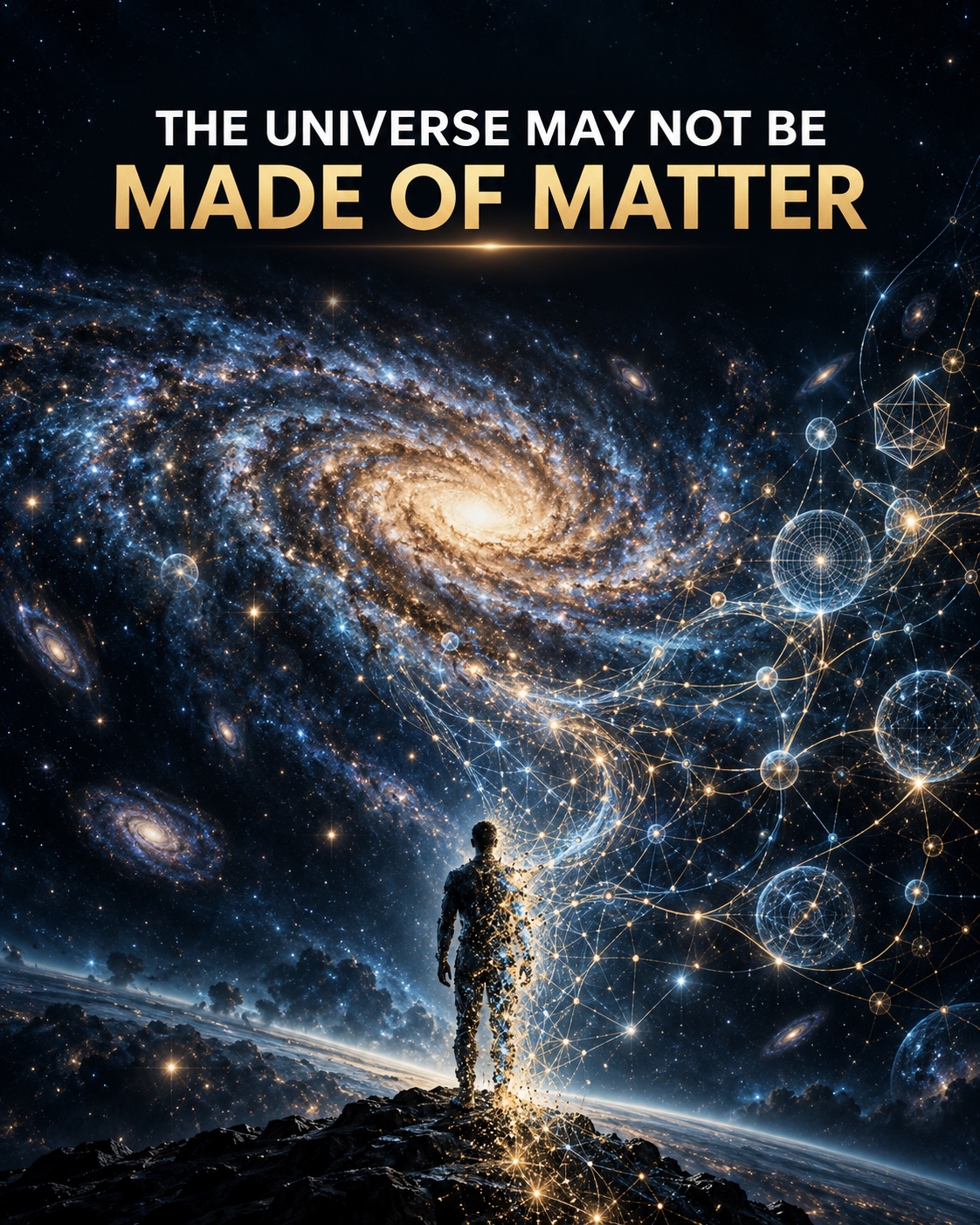
Universe represented as a luminous quantum information network

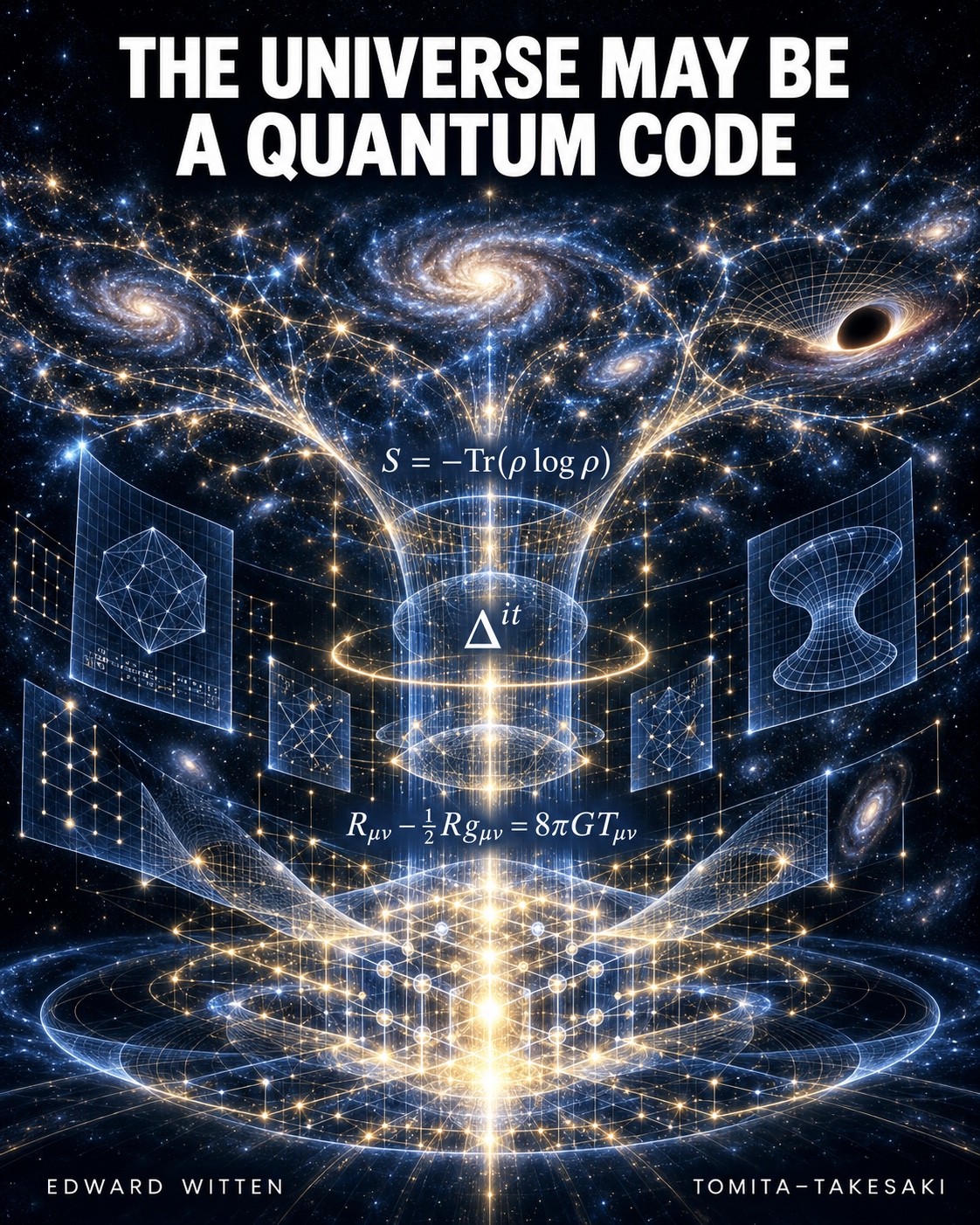
The Universe May Be a Quantum Error-Correcting Code

The mathematics used to protect information in quantum computers also appears in models connecting a gravitational bulk to its holographic boundary.

Read the full article

What if the cosmos is not fundamentally built from matter? What if reality is built from information?

One of the most fascinating ideas in modern theoretical physics suggests that aspects of spacetime may emerge from mathematical principles resembling those used to protect data inside quantum computers.

Researchers studying holography and quantum gravity discovered a surprising connection between the geometry of spacetime and quantum error-correcting codes. These codes are designed to protect information from noise and corruption, yet related mathematical structures reproduce key properties of certain gravitational systems.

The implication is striking: the fabric of spacetime may behave, in some theoretical models, like an information-encoding system.

In this picture, space is not fundamental. Distance is not fundamental. Geometry emerges from deeper quantum relationships. Information located in a gravitational “bulk” can be redundantly encoded on a lower-dimensional boundary, allowing it to remain reconstructible even when part of that boundary description is unavailable.

This perspective has become an important clue in the search for a theory that unifies gravity and quantum mechanics. It also helps researchers investigate how information might be preserved in systems involving black holes.

If the connection reflects a deeper law of nature, the universe may be less like a classical machine and more like a robust quantum information structure.

The ultimate laws of nature might not be written only in matter. They may also be written in information.

Scientific status: Holographic quantum error correction is a well-developed theoretical framework and a useful model of bulk–boundary reconstruction. The statement that the entire real universe is literally a quantum computer or a quantum code has not been experimentally established.

Sources • Almheiri, Dong & Harlow (2015). Bulk Locality and Quantum Error Correction in AdS/CFT. • Pastawski et al. (2015). Holographic Quantum Error-Correcting Codes: Toy Models for the Bulk/Boundary Correspondence. • Maldacena, J. (1998). The Large N Limit of Superconformal Field Theories and Supergravity.

Almheiri, Dong & Harlow · arXivPastawski et al. · arXivMaldacena · arXiv